
Is it possible to rationalise the best time to add specific hops into the wort boil? Not simply to maximise their bittering potential (that’s simple), but to extract and retain their flavour potential. This is the question I asked myself. Brewing is my second career, I started my working life as a problem solving chemist underpinned by a Ph.D in chemical mechanisms. Thus it has always been useful to me to understand the reasoning behind how a process is run. The why behind the what. So whilst it’s clear that late addition hops will lose less of their essential oils to evaporation, would it be possible to come up with an overall theoretical basis for which any hop flavour is best obtained at specific times within the boil? (not just the trendy ones.) I think the answer is yes.
I’ll not squander your time on the ideas that didn’t work and cut to the chase. When I drew up a list of all the essential oils which I could name if was clear that different flavour classes fell into different chemical functional group classes. i.e. All woody and spices flavour oils are higher molecular weight (MW) hydrocarbons or oxidation products of these. Citrus flavours come from low molecular weight (C10) unsaturated terpenes / terpene alcohols and so on. Here is my list of those chemical classes:
|
Aroma / Flavour |
Chemical class |
|
Spicy / Herbal |
Oxidation product (high MW) |
|
Woody |
Oxidation product (high MW) |
|
Purely spicy |
Oxidation product (low MW) |
|
Passion Fruit |
Thiol |
|
Tropical Fruit |
Thiol |
|
Citrus |
Unsaturated oxygenate |
|
Floral |
Unsaturated oxygenate or Biotransformate |
|
Pine |
Terpene |
|
Resinous |
Terpene |
|
Grassy |
Aldehyde (low MW) |
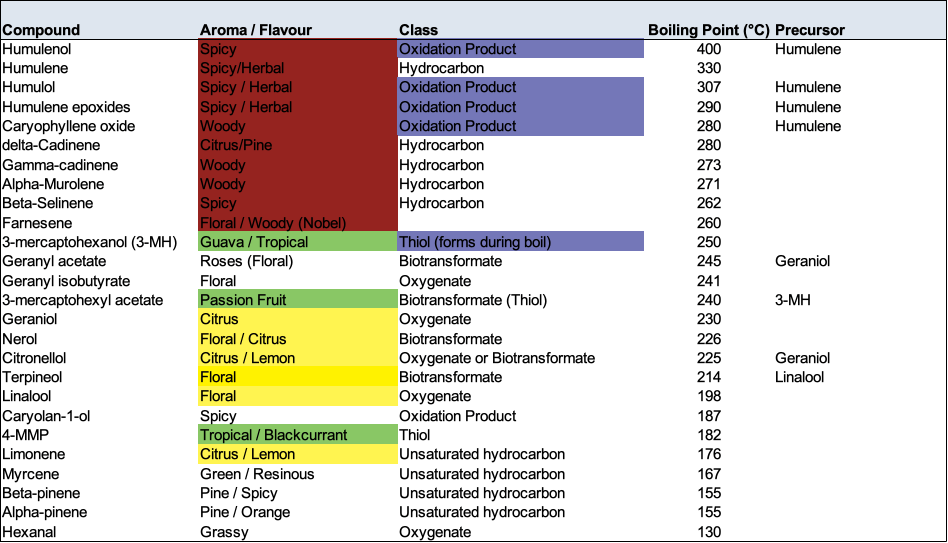
If you then list the oils by boiling point, the rationale behind their use starts to becomes clear.
So what do we learn?
-
Hop derived traditional British beer flavours can survive from the first wort hop additions because of their high boiling point.
-
In general spicy herbal flavours are likely to require a reasonable length of time in the boil to facilitate their oxidation to epoxides, probably at least 20 minutes.
-
Experience suggests that oils with a boiling point below 230 C are readily lost and should be added at the whirlpool.(1)
-
Flavours from biotransformation are best achieved by dry hopping or whirlpool additions.
-
Add to the above knowledge the very low concentration of thiols present in hops and you can see that tropical flavours are only likely to be obvious from whirlpool or dry hop additions.
On these basis we can rationally add hops into the wort at the point which will maximise the flavour component we are seeking. So take Perle hops for example, which can offer both spicy and orange flavours. The spicy flavours would be best gained by adding in the flavour section to (+20 / +30 min) to allow time for oxidation. However, if we want the pine / orange flavours from this hop then this would be best achieved at the whirlpool. Observations such as this explain why the addition of the same hop at different stages of the boil can give a greater breadth of flavour to the beer. The same is true with dry hopping where additions during active fermentation should be expected to yield more biotransformation flavours that those added during warm conditioning. Thus a rationale for double dry hopping, but only if the correct hop varieties are used (those containing Geraniol / Linalool). Although I still suspect that the DDH moniker is more of a marketing term than a zymological one.
What I’d like to do next is to tabulate the flavour threshold of all of these oils to see what extra insight this sheds into the area. Highly experienced brewers are likely to have come to the above conclusions simply through their breadth of experience, but I know I’ve found it satisfying to bring some rational (ab initio) light to shine on this question.
I would really love to hear your constructive feedback on these ideas.
(1) 85% of hop oils added at the start of a wort boil are lost during the boil – F.R. Sharpe & D.R.J. Laws, J. Inst, Brew, 1981, vol 87, 96-107.
Acknowledgements: My thanks to Will Rodgers at Charles Faram and Thomas Shellhammer at Orgegon State University for helpful discussions
 Hop Doctor