
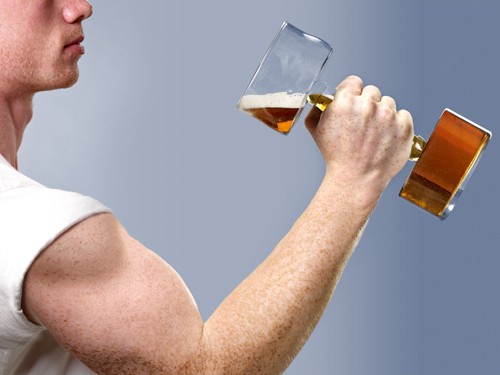
The body of a beer makes a big difference to the drinking experience. The amount of body that you target depends on both the style and the drinking audience you are aiming for, but for an excellent beer it needs to fit the style. The beauty of the brewing process is that there are a very wide range of variables you can play with to adjust the body of your beer.
There is a view, to which I also subscribe, that the ideal craft beer will taste as if it is 5% ABV. That means that our beer design may be seeking to increase the body of a low ABV example but reduce the body in an imperial stout. It’s like going to the gym, some people are there to increase their tone and muscle bulk, others are looking to shed a few pounds.
What is body?
This is the first thing to understand, because when you, the rationale behind the process variables that influence it become clear. Predominantly the body of a beer (or any beverage) is related to the viscosity. Viscosity, for those who are interested, is the resistance to flow within a liquid. Think of water at one end of the range and honey at the other. Other key factors that influence how we perceive the body of a beer are the sulphate:chloride ratio and the level of carbonation. These factors are important but are secondary to the viscosity.
So what influences the viscosity of beer?
Simple, the higher the amount of dissolved solids and the higher the molecular weight of those solids the higher the viscosity of the beer. Considering a 4.4% European Pilsner for example; we would expect around 3% unfermented sugars and 0.3% protein to be the major dissolved solids. It is worth remembering that the molecular weight (MW) of the proteins present could easily be 10-20 times higher than the unfermented sugars, so their effect will be higher than their concentration seems to suggest.
INCREASING BODY
We could simply increase the ABV, because as this rises so does the total sugar content of the wort. Whilst the relative percentage of unfermentable sugars remains the same, their absolute level rises. Thus the higher body we generally experience in stronger beers.
But let’s say we are looking to make a session beer at 3.7% but we don’t want it to taste watery, what options do we have?
-
Careful choice of the malt bill
-
Add an adjunct that contains higher molecular weight proteins
-
Select the best mash temperature
-
Consider a step mash
-
Use a lower attenuation yeast
-
Use a lower sulphate:chloride ratio in your brewing salt addition/s.
-
Add lactose
Malt choice
This is one of the two most powerful tools you have open to you, the other being your choice of yeast. Crystal malts are commonly used to increase the body of a beer, their unique malting process leads to caramelised sugars being present in the malt itself. If you don’t want to also add strong flavours then choose a lightly kilned version – often called Cara malts, these will add a little sweetness but not the stronger caramel or dried fruit flavours of the darker crystal malts. Note that crystal / cara malts have a very low enzymic potential so should only be used at < 10% of the total malt bill. Another option is Munich malt but this has a higher flavour potential so is often best used in darker beers where it’s maltiness will be a welcome layer of flavour rather than a distraction.
Lower Attenuation Yeast
An alternative to putting more body in is to take less out! Lower attenuation yeasts such as Fermentis S-33 or Lallemand BRY-97 are more selective in the sugars they convert and thus leave more behind the final beer. If you use one of these you may want to do something counter-intuitive with your mash temperature so your final gravity is not too high and that is to mash in at a lower temperature (i.e. 65 C).
Adjuncts
It is common to add oats or wheat to increase the body of the beer. Be careful with the level you use though. Both adjuncts contain larger molecular weight proteins, some of which will be left, like a sludge, in your mash tun. High levels will also lead to a lack of haze stability, which can be a problem or an advantage depending on the style you are aiming for. Oats also add beta-glucans and other viscous polysaccharides to the beer, but if you add too many, the viscosity of your mash will rise and increase your sparge / run off times or may lead to a stuck mash. The lack of husk on malted wheat can also lead to similar problems albeit via a different route. If you are using as mash tun, then add your wheat to your grist hopper towards the end so the wheat does not sit directly above the plate.
If your brew kit allows for a step mash, then it is possible to extract more of the medium molecular weight proteins from these adjuncts by including a protein rest. This breaks down the problematic high MW proteins (less sludge) to form more of the ‘body building’ medium MW proteins which are wanting to move forwards in the process.
Mash temperature
A subtle change here can have a significant effect on your final beer. You have competing enzymes in your malt and at higher temperatures α-amylase wins out leading to a higher level of more complex, lower fermentability sugars and with this, more body.
Adjust your brewing salts
Higher relative levels of chloride in a beer are known to increase the perceived body. With something like a Stout you would want higher chloride levels anyway to bring out the lovely malt flavours. A less obvious example of this approach is with NEIPA’s. Whilst these beers have a very high hop level, the style demands a lower bitterness and also uses low colour malts so there is little or no malt character to be enhanced. NEIPA’s are commonly made with a 1:2 – 1:3 sulphate:chloride ratio.
Add Lactose
Finally, you could simply add a non fermentable sugar to build you body, an approach traditionally used with a Milk Stout. Lactose is a lot less sweet than sucrose but is sweet nonetheless, so be cautious in the amount you add if you take this route, start with something in the 3-7% range.
REDUCING BODY
If you are one of the mega brewers then one of your aims is to make a lager which is easy to drink, something with less body that you would expect for the ABV. This is one of the reasons why Budweiser is made with some rice within the malt bill. If you are reading this you are probably not seeking to make the next Bud Light, but the same principles apply. A beer whose body is too high is less satiable; it is something where a half might be enough. If you want to make a high ABV beer more session-able, what options do you have open to you?
-
Add an adjunct
-
Select the best mash temperature
-
Use a higher sulphate:chloride ratio in your brewing salt addition/s.
Add an adjunct
Mash adjunct
There is no shame in using some rice within your malt bill. But you need to use it in the right form and at the right level. It is necessary for all starch sources to gelatinise (hydrate and open up ready for the enzyme action) and is it really handy that malted barley does this between 61-65 C so this happens without you having to think about it. Rice however requires 70-80 C. Mega-breweries have a separate vessel for this step, but as a micro-brewer you can buy Flaked Torrified Rice which has been ‘pre-gelatinised’ and is ready to charge into your mash tun. Something else to note is that rice has no enzymic power and very low FAN (link to definition), so needs to be partnered with barley malt to enable saccharification and yeast health. Keep the level below 25%.
Kettle adjunct
Rice lowers body because it produces a much higher percentage of fermentable sugars than malted barley. Another approach to achieve this would be to add simple sugars directly into the copper. This is the approach used by the Belgians to make beers North of 10% ABV which do not feel like treacle. Sugar syrups, candy sugar and honey are all options. These are 100% fermentable so give you alcohol without the body.
Mash temperature
The opposite approach to body boosting applies here of course and that is to aim at a lower mash temperature to favour β-amylase and thus gain a higher proportion of fully fermentable maltose.
Adjust your brewing salts
Here your exact approach will depend on the style you are aiming for. You want to increase the sulphate:chloride ratio but the extent will depend on the style. For a malt forward beer you are likely to want to keep a modest excess of chloride – say 1:1.25 but for a double IPA you be be free to go for 3-4:1. Here you are looking for a subtle malt backbone at most and are likely to want the bitterness to balance well with what is likely to be a higher level of background sweetness.
Final comments
A commercial beer design needs to both good to drink and practical to manufacture. As you have now seen we have plenty of factors at our disposal. Which we choose to use will depend on the style being targetted and capability of the brew kit we have at our disposal. If you are want some guidance with beer design, or help with practical processing problems then please give me a call and we can arrange a phone/video consultation or, if you are based in the North West of England a site visit.
 Hop Doctor
Superb depth of knowledge written so understandably well it was a joy to read and just at the right time for me on me brewing journey. Just set up a nano brewery as a Ltd company and we are hoping to be in production by March. Thank you
Warm regards Nick
Treehouse brewery ltd
LikeLike
Pingback: Malts with Superpowers… | Hop Doctor
Interesting read. It’s far from self evident that a beer can be made reliably distinguishable by mash temperature alone (even when the mash temperature precludes an ABV difference of up to 2%). People just can’t appear to tell the difference in this series of experiments: https://brulosophy.com/2022/01/10/exbeeriment-mash-temperature-low-vs-high-in-a-german-pils/
There’s evidence to support that long chain sugars left in a beer mashed at a high temperature contribute neither perceptible sweetness or body (at least not at the levels that can be controlled by mash temperature or the addition of carapills/crystal malts etc): http://scottjanish.com/dextrins-and-mouthfeel/#:~:text=In%20the%20study%2C%20mashing%20of,wort%20to%20around%20185℉.
It just all seems very elusive. One thing you didn’t mention in your article is varying glycerol production of different yeast strains or how glycerol production for a given strain is influenced by fermentation profile. I’m not aware of any definitive list of glycerol production by yeast strain, are you?
I’ve found carbonation levels to be a big driver in the mouth-feel and body of a beer, getting it dialled in can make a substantive difference, especially in stouts/porters & NEIPAs. Obviously then there’s nitro, though that strays a little from the scope of your article…
Cheers!
LikeLiked by 1 person
The experimental methods used on Brulosophy often leave a lot to be desired in my experience. I know I can tell the body difference between a 65 C and 69 C mash. That said, I think the impact of residual sweetness is more sensitive. I’ve not looked into impact of yeast strain on glycerol levels , that sounds interesting. That said, most of my clients settle on just one or two yeast strains once they’ve tried a few. Larger breweries tend to stick to one ale and one lager strain so yeast cropping is easier to manage. Thanks for getting in touch.
LikeLike
No worries, thanks for the interesting blog! Always well written and never fails to get me thinking. When you say you take issue with some of their methods, are we talking experiment design or their statistical modeling?
LikeLike
Their experimental designs are often flawed
LikeLike