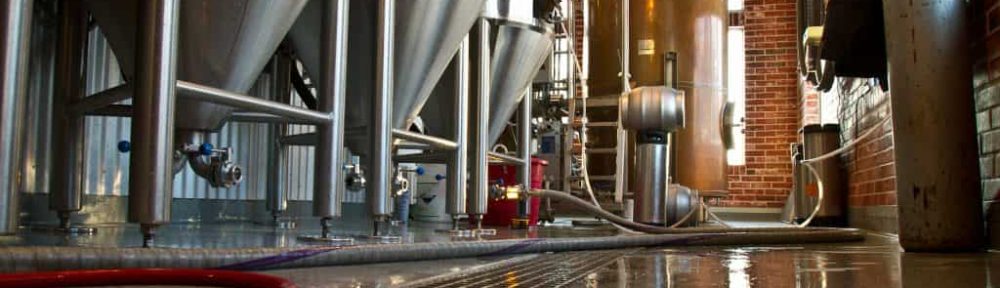
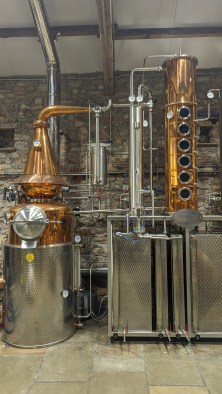
A new whisky distillery has opened near to me, so I got in touch to see if they wanted anyone to help making their wash. The owner got back to me the next day to ask if I could help with issues with stuck mashes and slow fermentations.
What might not be obvious to anyone new to the field is that the precursor to whisky spirit is something very akin to beer, but without any hops. I always offer the first hour of consulting time free so I can decide if I can add value for the customer and they can get confidence in the knowledge which I offer. We were soon having a fruitful conversation and the reason for their slow / stuck fermentations became obvious after running a forced fermentation test – they had the wrong mix of sugars in their wort (or wash as it’s called in this industry). Could I help to resolve this? Could I optimise their yield to sugar in the wash and could I advise on best practice CIP methods? Yes, yes, yes!
The benefit of employing someone like me is that my Ph.D background allows me to get up to speed in a new topic in hours, not weeks. Understanding the subtle but important differences between wort and wash production made for fascinating reading. In beer production we choose the mash temperature to control the sweetness and body of the final beer, with whisky one is looking to maximise fermentable sugar extraction. To achieve this the grist is mashed at low temperature, almost all the strong worts are run off and then it is subject to a kind of pseudo step mash by sparging at 75 C to activate the α-amylase to convert areas of the starch which are sterically inaccessible to the β-amylase. But since non-fermentable sugars are of little value to the whisky maker, the wort is not boiled but (cooled and) transferred directly from the mash tun to the FV. Here speed of operation is key because the aim is to transfer active enzymes, including limit-dextrinase, into the FV. As the fermentation progresses these enzymes work on the complex sugars to form maltose which can then be converted to alcohol. Thus efficient operating practices will boost the yield to alcohol.
By observation it was clear that the HX (heat exchanger) which had been installed was far too small which was increasing processing times.

A new HX is now on order, but in the mean time it was important to get production running. Employing a trick to make Brut IPA I advised on an exogenous enzyme we could add to the FV to allow the fermentations to run to completion whilst the new HX is awaited. Roll on two weeks and all fermentations are now reaching their desired terminal gravity and I have given hands on help and coaching which has boosted the sugar extraction yield from 67 to 93% and I aim to increase this still further.
Now my role has moved on to training the guys who are going to be running the brewing side of the process, write some SOP’s (best practice training is always based on an SOP) and help embed consistency of operation and thus yield and flavour profile. It is really satisfying to use my process support skills from my time in the chemical industry in parallel with my technical understanding of the biochemistry of brewing to help yield good consistent spirit in good yield. I must confess to be rather enjoying myself.
 Hop Doctor