Understanding the Hop Stability Index: Key for smaller scale brewers

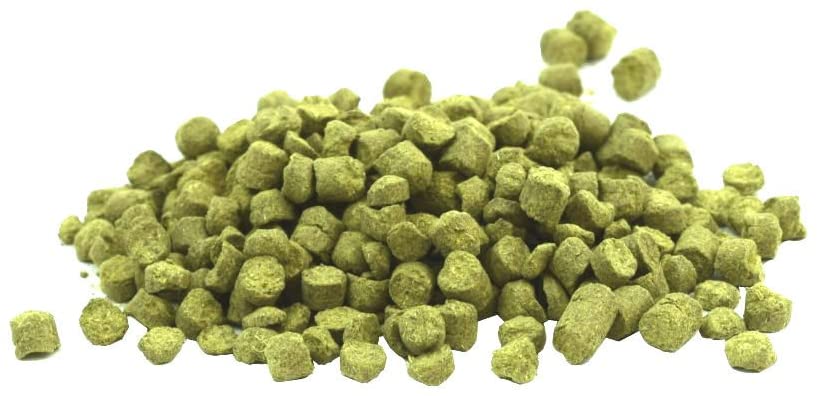
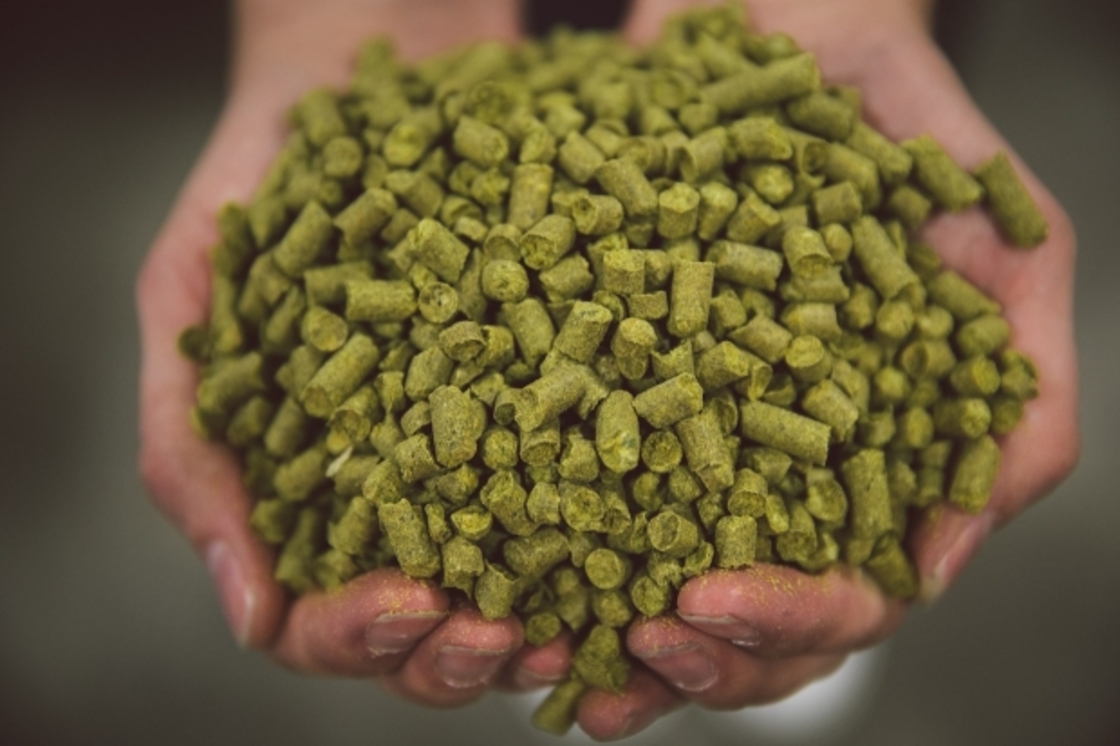
hop pellets

All hops degrade with time, especially if in contact with air. The HSI (Hop Stability Index) is a measure of the rate of oxidation of the alpha and beta acids with time. The value quoted relates to the extent of oxidation of these bittering acids when in the presence of air at 20 °C over a period of six months.

Why is this important?

Whilst the bittering potential of an open package of a high HSI hop will reduce significantly over time, it is not the economics which matter most to a brewer who only only brews infrequently or at a small scale. The issue which should concern you is a change in the nature of the bitterness which is imparted. As the bittering acids oxidise their flavour changes, and rather than the typical neutral bitterness you want, you are likely to get a vegetal like bitterness; like that you would get with overcooked cabbage or sprouts. This is not pleasant.

How do I avoid this problem?

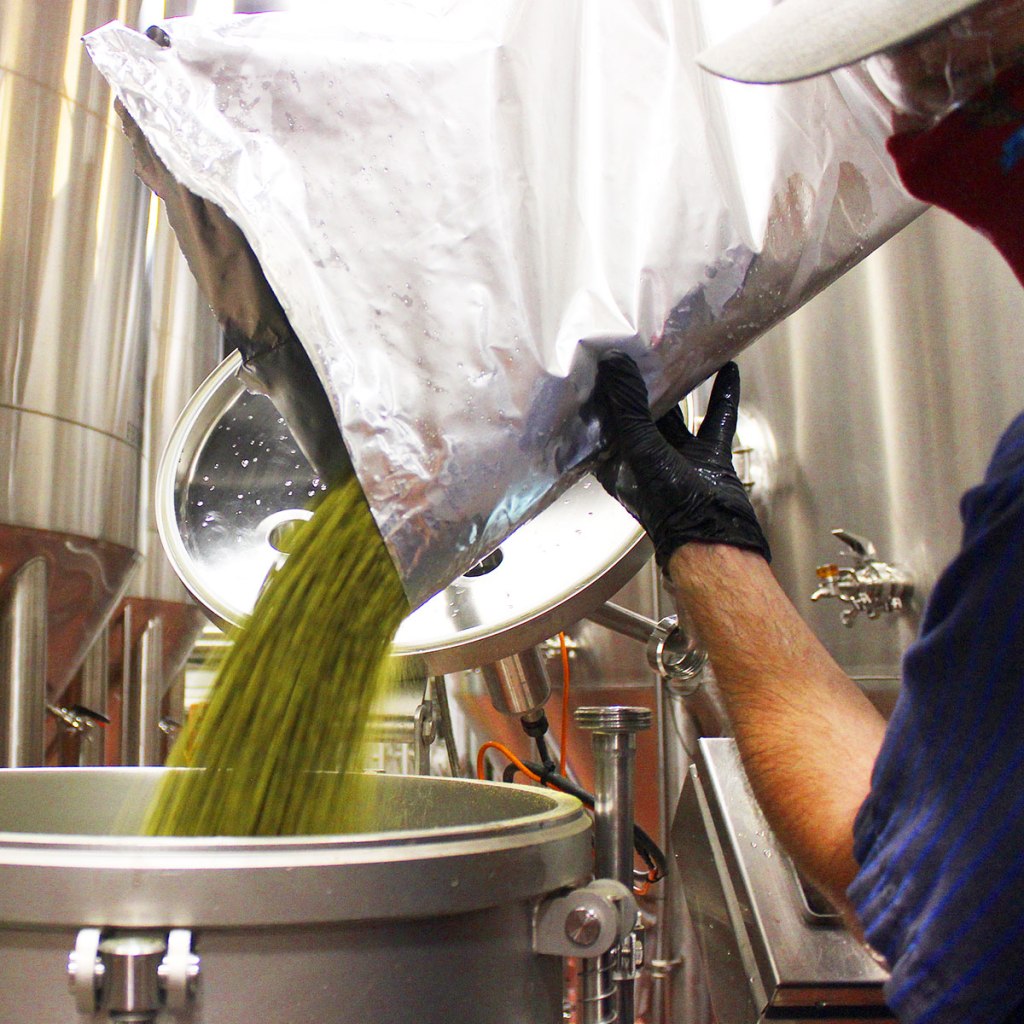
All the time your hop pellets are in sealed, oxygen free, bags they cannot oxidise. It is open bags, which are now in contact with oxygen where you will have a problem. For more information, see this article. It is good practice to chill all of your hops, but this is even more important once the bag has been opened. If you want to store an open bag of hop pellets for more that a few weeks you are best advised to seal the bag as best you can and keep in a freezer. Larger breweries will use whole bags of pellets / whole tins of extract either within a batch, or within the week and this overcomes the issue, but for smaller producers, like brew pubs, or new smaller businesses this is not going to be an option.

The easiest and most practical option to manage hop acid oxidation is to choose your hop varieties carefully. Look up the characteristics of several hop varieties which give you the properties / flavour profile you are looking for, and choose only hops where the HSI is < 30%. To exemplify this consider Columbus, this is a very high alpha acid hop, seemingly ideal as a bittering hop. However the HSI is 45% and thus is not a variety I’d recommend to smaller breweries who will not use a whole bag within a fortnight. Similarly Centennial is a sublime aroma hop for lovely, well retained citrus / grapefruit flavours (see my article concerning hops whose flavour with the best retention into the final beer) but again it has a high HSI and will start to give you unpleasant flavours if the bag has been open for more than 2-3 weeks.

Good hop choices

Fortunately we are now blessed with such a broad range of hop varieties that, with access to the right knowledge one can choose a hop which has the flavours you want and is practical for your scale of operation. Here are some examples to get you started…

Variety

Duty

Flavour

HSI / %

( < 30% is good)

Pacific Gem

Bittering

N/A as FWH (link)

22

Apollo

Bittering

N/A as FWH (link)

15

Citra

Dual purpose

Citrus

27

Chinook

Aroma

Citrus / Pine

29

Rakau

Aroma

Tropical Fruits

21

El Dorado

Aroma

Tropical Fruits

30

Dana

Aroma

Floral

28

Cascade (US)

Aroma

Floral

36 (borderline, ok in practice)

Goldings (UK)

Dual Purpose

Woody / Herbal

22

Northern Brewer

Dual Purpose

Woody / Herbal

30

Whisky Galore! Boosting the yield of wash production for a whisky client

PXL_20231208_141206513

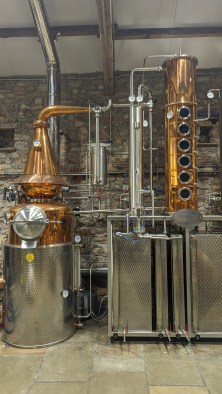
A new whisky distillery has opened near to me, so I got in touch to see if they wanted anyone to help making their wash. The owner got back to me the next day to ask if I could help with issues with stuck mashes and slow fermentations.

What might not be obvious to anyone new to the field is that the precursor to whisky spirit is something very akin to beer, but without any hops. I always offer the first hour of consulting time free so I can decide if I can add value for the customer and they can get confidence in the knowledge which I offer. We were soon having a fruitful conversation and the reason for their slow / stuck fermentations became obvious after running a forced fermentation test – they had the wrong mix of sugars in their wort (or wash as it’s called in this industry). Could I help to resolve this? Could I optimise their yield to sugar in the wash and could I advise on best practice CIP methods? Yes, yes, yes!

The benefit of employing someone like me is that my Ph.D background allows me to get up to speed in a new topic in hours, not weeks. Understanding the subtle but important differences between wort and wash production made for fascinating reading. In beer production we choose the mash temperature to control the sweetness and body of the final beer, with whisky one is looking to maximise fermentable sugar extraction. To achieve this the grist is mashed at low temperature, almost all the strong worts are run off and then it is subject to a kind of pseudo step mash by sparging at 75 C to activate the α-amylase to convert areas of the starch which are sterically inaccessible to the β-amylase. But since non-fermentable sugars are of little value to the whisky maker, the wort is not boiled but (cooled and) transferred directly from the mash tun to the FV. Here speed of operation is key because the aim is to transfer active enzymes, including limit-dextrinase, into the FV. As the fermentation progresses these enzymes work on the complex sugars to form maltose which can then be converted to alcohol. Thus efficient operating practices will boost the yield to alcohol.

By observation it was clear that the HX (heat exchanger) which had been installed was far too small which was increasing processing times.

PXL_20240104_154525690

A new HX is now on order, but in the mean time it was important to get production running. Employing a trick to make Brut IPA I advised on an exogenous enzyme we could add to the FV to allow the fermentations to run to completion whilst the new HX is awaited. Roll on two weeks and all fermentations are now reaching their desired terminal gravity and I have given hands on help and coaching which has boosted the sugar extraction yield from 67 to 93% and I aim to increase this still further.

Now my role has moved on to training the guys who are going to be running the brewing side of the process, write some SOP’s (best practice training is always based on an SOP) and help embed consistency of operation and thus yield and flavour profile. It is really satisfying to use my process support skills from my time in the chemical industry in parallel with my technical understanding of the biochemistry of brewing to help yield good consistent spirit in good yield. I must confess to be rather enjoying myself.

Which hop oils survive from the hot side – some recent research from Yakima Chief

My last post on hop addition timing attracted a lot of interest and someone from Yakima Chief reached out to me with a technical data-sheet which they published in 2021. I’ve shown the key chart below which quantifies the nature and level of hop flavour oils which they have detected in a finished beer vs. species and addition time.

hop-pellets

They don’t specify their methodology but compare a set of hop species whose oil content has the combination of concentration and properties (solubility, boiling point etc) which helps them to remain in the beer from the hot side and those whose qualities mean they are best added as a dry hop.

Species

Flavour / Comment*

2-Nonanone

Cheesy / Herbal

Geraniol

Floral

Linalool

Citrus / Fruity

2-Methylbutyl isobutyrate

Fruity / Apricot

Methyl Geranate

Floral

Isoamyl isobutyrate

Apricot / Banana

3-Mercaptohexanol

Tropical / Grapefruit

* A flavour combination is often different from the sum of it’s parts.

Information of hop oil composition is hard to find, so whilst the chart is only qualitative and only covers US varieties it does give a good guide to a range of 20 popular aroma hops. I know that one use I will be able to put this to is to combine hops with different oil profiles to better maximise the breadth of flavour experience in my beers.

A copy of the full data-sheet can be downloaded from here or here. If you are a micro-brewery wanting help with a beer design, please do get in touch and let’s see how I might help.

Towards a theory to explain the best time for hop additions

Is it possible to rationalise the best time to add specific hops into the wort boil? Not simply to maximise their bittering potential (that’s simple), but to extract and retain their flavour potential. This is the question I asked myself. Brewing is my second career, I started my working life as a problem solving chemist underpinned by a Ph.D in chemical mechanisms. Thus it has always been useful to me to understand the reasoning behind how a process is run. The why behind the what. So whilst it’s clear that late addition hops will lose less of their essential oils to evaporation, would it be possible to come up with an overall theoretical basis for which any hop flavour is best obtained at specific times within the boil? (not just the trendy ones.) I think the answer is yes.

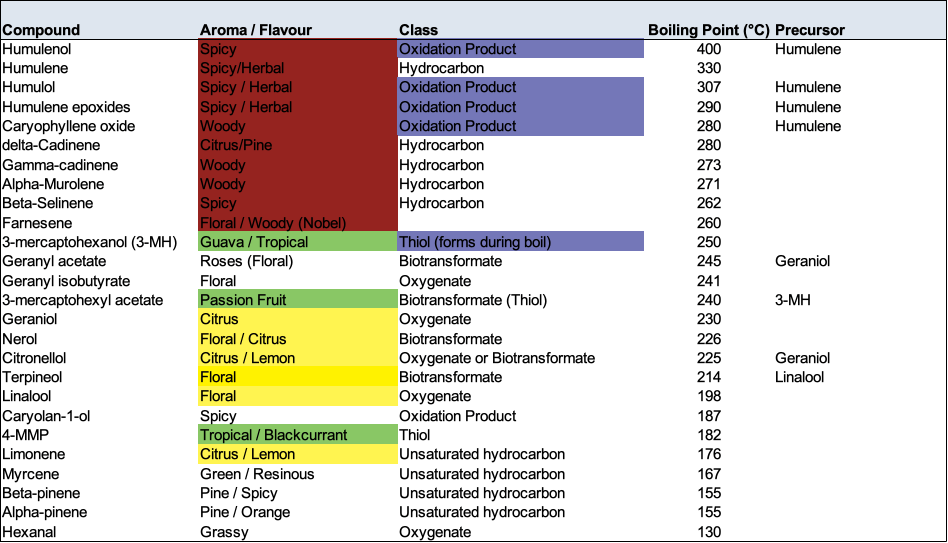
I’ll not squander your time on the ideas that didn’t work and cut to the chase. When I drew up a list of all the essential oils which I could name if was clear that different flavour classes fell into different chemical functional group classes. i.e. All woody and spices flavour oils are higher molecular weight (MW) hydrocarbons or oxidation products of these.  Citrus flavours come from low molecular weight (C10) unsaturated terpenes / terpene alcohols and so on. Here is my list of those chemical classes:

Aroma / Flavour

Chemical class

Spicy / Herbal

Oxidation product (high MW)

Woody

Oxidation product (high MW)

Purely spicy

Oxidation product (low MW)

Passion Fruit

Thiol

Tropical Fruit

Thiol

Citrus

Unsaturated oxygenate

Floral

Unsaturated oxygenate or Biotransformate

Pine

Terpene

Resinous

Terpene

Grassy

Aldehyde (low MW)

If you then list the oils by boiling point, the rationale behind their use starts to becomes clear.

So what do we learn?

  • Hop derived traditional British beer flavours can survive from the first wort hop additions because of their high boiling point.

  • In general spicy herbal flavours are likely to require a reasonable length of time in the boil to facilitate their oxidation to epoxides, probably at least 20 minutes.

  • Experience suggests that oils with a boiling point below 230 C are readily lost and should be added at the whirlpool.(1)

  • Flavours from biotransformation are best achieved by dry hopping or whirlpool additions.

  • Add to the above knowledge the very low concentration of thiols present in hops and you can see that tropical flavours are only likely to be obvious from whirlpool or dry hop additions.

On these basis we can rationally add hops into the wort at the point which will maximise the flavour component we are seeking. So take Perle hops for example, which can offer both spicy and orange flavours. The spicy flavours would be best gained by adding in the flavour section to (+20 / +30 min) to allow time for oxidation. However, if we want the pine / orange flavours from this hop then this would be best achieved at the whirlpool. Observations such as this explain why the addition of the same hop at different stages of the boil can give a greater breadth of flavour to the beer. The same is true with dry hopping where additions during active fermentation should be expected to yield more biotransformation flavours that those added during warm conditioning. Thus a rationale for double dry hopping, but only if the correct hop varieties are used (those containing Geraniol / Linalool). Although I still suspect that the DDH moniker is more of a marketing term than a zymological one.

What I’d like to do next is to tabulate the flavour threshold of all of these oils to see what extra insight this sheds into the area. Highly experienced brewers are likely to have come to the above conclusions simply through their breadth of experience, but I know I’ve found it satisfying to bring some rational (ab initio) light to shine on this question.

I would really love to hear your constructive feedback on these ideas.

(1) 85% of hop oils added at the start of a wort boil are lost during the boil – F.R. Sharpe & D.R.J. Laws, J. Inst, Brew, 1981, vol 87, 96-107.

Acknowledgements: My thanks to Will Rodgers at Charles Faram and Thomas Shellhammer at Orgegon State University for helpful discussions

Malts with Superpowers…

The current craft beer scene has it’s focus on hops, these are the celebrities of today’s beer. But behind every great hop there has to be a great malt base!

A great beer is more than just aroma. The first thing that a customer assesses about a beer is it’s appearance and that is shaped by the malt bill. Whether you are looking for clarity or murky haziness, a brim full glass or a deep long lasting head these aspects come from the malt (and/or adjuncts) which form the grist. The range of malts available to us today is a veritable kaleidoscope

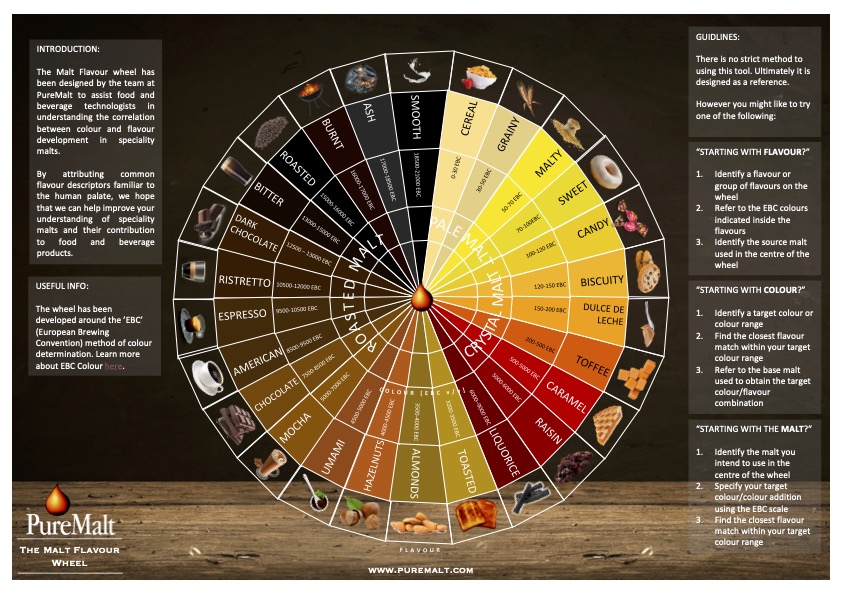
PureMalt Flavour Wheel

There is such a breadth of flavour options there, but the topic for this post are the less obvious characteristics which we can use to impact the more subtle but equally important aspects of our beer design.

Clarity or Haze…

The current trend in the UK is for hazy IPA’s. Permanent haze in beer comes mainly from protein-polyphenol complexes or beta-glucan and related polysaccharides. But you need the right protein, not just any protein. Here you should be looking at malted wheat. Torrified wheat has a high haze potential, but being ‘less-modified’ the protein fraction is of a larger molecular weight which tends to drop out with time. To further aid the haze and to give that ‘pillowy softness’ then use some malted oats which contribute beta-glucan / polysaccharides to achieve these effects. Don’t go crazy with the amount you use however as the lack of husk on the wheat or the beta-glucans in the oats could make for a very slow run off from your mash tun.

What if your aim is a beer of the ultimate clarity? This is probably best achieved by good water chemistry, careful optimisation of your boil time, kettle and auxiliary finings. But if you are working at the micro scale then finings optimisation trials are not always an easy option. Did you know that the major source of the polyphenols behind haze is the base malt, not the hops? Crisp offer a malt which they call ‘Clear Choice’ which is malted from a unique variety of barley which is free from the class of polyphenols which help form haze complexes. For an easy option at the small scale this could be something to consider.

Body

One of my earlier posts  covers the various ways you can control the body of your beer. There’s no point repeating all that here just head to my post on bodybuilding. Suffice it to say that wheat and oats are again good choices, and if you are making a Stout consider some Munich malt which adds both body and some lovely complexity to the malt base.

Colour

Clearly the range of differently roasted malts offer a full palate of colour options for your beer. But what if you want to add the colour without the flavour? Here I’m thinking about something like a Red Ale or a Black IPA. Here Black Malt is your friend, but don’t add it to the mash, spread it over the top of the mash bed just before you start sparging – in this way you get a lot of the colour and very little of the flavour extracted.

Another related trick is needed if you want to make a lager that looks and tastes like it has been made via the traditional decoction method, but when you don’t have the kit or the patience to use this approach. The boil stage of decoction promotes the Maillard reaction yielding melanoidins. A similar effect can be achieved used a small proportion (2%) of Melanoidin malt within your malt bill. Here the melanoidins have been formed during the roasting process

Finally, if you want to get the colour and flavour from a roasted malt without the astringency then consider some dehusked malt such as one of the Carafa Special grades from Weyermann or Blackprinz from Breiss. Many of the polyphenols in barley is within the husk, if it’s not there it cannot impart the astringency. Also important with a stout is to get your pH right by adding some bicarbonate to a Stout Grist to keep the pH up to around 5.4. Dark roasted malts, rich in acidic melanoidins will reduce the pH in the mash and reduce your extract efficiency unless you correct for this.

Sweetness

Crystal / Cara malts are made via a different process to regular malts. Rather than being drying directly after malting, they are heated to a comparable temperature in a sealed drum so that they are ‘stewed’ before drying and roasting. This starts the saccharification process and the sugars become caramelised during the drying / roasting stages. A whole range of colour options exist. The most crushable hoppy beers of today have a backdrop of subtle sweetness to bring out the best of the fruity flavours from the hop oils. Pale Cara malts (15-25 EBC) are used to achieve this. Hops might seem to win all the Oscars, but Cara malt should win a gong for the Best Supporting Role.

For malt forward beers where sweetness is also important, some of the darker Crystal malts come into their own. These give toffee (Crystal Pale / 150) or caramel and dried fruit (Dark Crystal / 400) flavours to both traditional and modern porters and stouts. What did you think put the popcorn into Northern Monkey’s Film Club?

In everything, moderation

Finally don’t forget the most important superpower of all, and that is the enzymic power within base malts which turns the starch into sugars – the source of our alcohol. Enzymes are delicate and high temperatures denature them. Both roasted and crystal malts no longer contain functional enzymes so have no diastatic power. Thus when using these malts never use more than 10% of each and always have at least 70% of base malt within the grist. The two exceptions here are Vienna and Munich malts which retain enough diastatic power to be used at up to 100% of the malt bill, so these can be counted towards your 70% too.

More help?

Would you like a beer recipe designed for you, and even made at pilot scale for you to try? I can offer both of these services and very soon I will have the AWRS licence required for you to test out your new brew on your own customers for their feedback because launching into a full scale batch. If either of these are of interest, just give me a call.

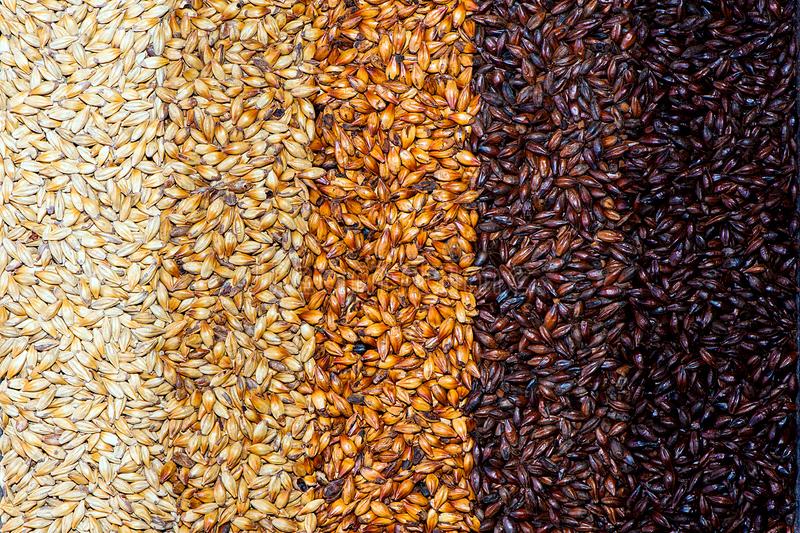
Malt colour-gradient